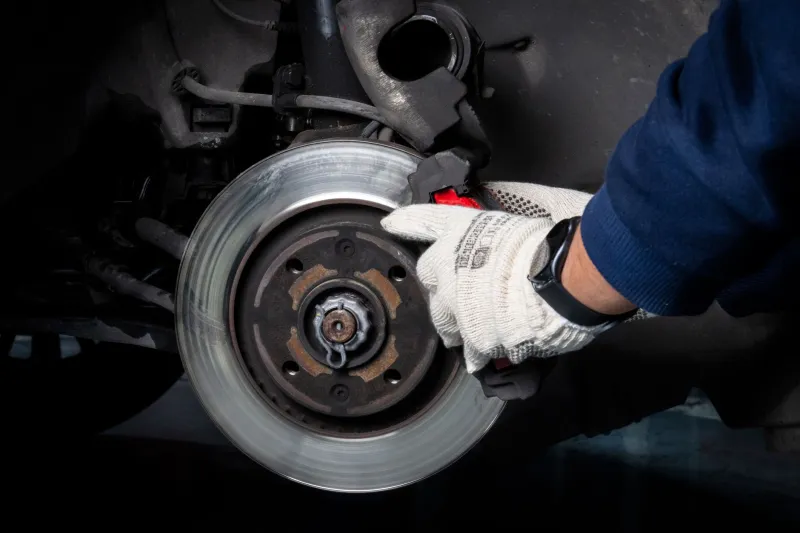
Water Finds a Way: The Post-Flood Forecourt Check for Bearings, Sensors and Connectors
Photo: S-Themis, CC BY-SA 4.0, via Wikimedia Commons
November has a way of turning a routine B-road into a brown canal. You see the puddle ahead, judge it against the wheel rims, and commit. Most drivers know the big fear: water into the air intake, a bent con-rod, a very expensive silence. But on a UK forecourt, the floodwater jobs that actually fill the diary are rarely the dramatic hydrolock cases. They are the quiet ones — the wheel bearing that starts humming three weeks later, the ABS light that comes on after a cold snap, the caliper that drags because water sat in the piston boot over a weekend.
Standing water does not need to reach the engine to cost you money. It only needs to reach a hub, a connector, or a caliper that was already past its best.
Why the Engine Isn't the Whole Story
Hydrolock is the headline act because it is instant and unmistakable. Water is patient. A wheel bearing is sealed, but seals are not invincible — especially on a car that has covered 80,000 miles on gritty British roads. Once water gets past the seal, it mixes with the grease and turns it into something closer to mayonnaise. The bearing does not fail at the puddle. It fails after the rollers have started to pit and the rumble becomes a drone.
ABS sensors live in an equally hostile place. They sit at the hub, exposed to spray, salt, grit and whatever the council spread last winter. The sensor head itself is often fine. The connector and the loom behind it are where water does its work. A plug that looks dry from above can hold a teaspoon of water in its boot, and that water sits there quietly corroding pins.
Brake calipers are the third member of the triangle. The piston boot is designed to keep out road dirt, not to be submerged. Water that gets behind the boot can start rust on the piston bore. The caliper may still work at the puddle. A few weeks later it starts to drag, the disc overheats, and the car develops a pull under braking that the driver notices on the motorway.
The Forecourt Inspection After a Wet Crossing
A garage that knows what it is looking at will not just check the air filter and send you on your way. The car goes up on the ramp and the inspection starts at the wheel arches. The technician is looking for silt lines — the fine grit that floodwater leaves behind when it drains. Silt on the back of a hub, inside an arch liner, or along a subframe tells you how deep the water actually was.
The wheel is spun and rocked to check for bearing play and roughness. The ABS sensor head is inspected and the connector is opened where accessible. The loom is flexed gently to look for water weeping out of the boot. Caliper slide pins and bleed nipples are checked for corrosion. Underbody trays and floorpan grommets are checked for missing plugs, because a displaced grommet lets water into places it should never reach.
On deeper crossings, the technician may also look at gearbox and differential breathers, and at any connector block that sits low in the engine bay. It is not a five-minute job, but it is a fraction of the cost of a hub assembly, a caliper and a morning of diagnostic time.
Symptoms That Show Up Weeks Later
The tricky part of floodwater damage is the delay. The puddle drains in minutes. The bill takes weeks to arrive. Watch for a wheel bearing rumble that changes with speed or steering direction. Watch for an ABS or traction-control light that appears after a bump or a damp morning. Watch for a brake pedal that feels slightly different, or a wheel that is hotter than the others after a short drive — a dragging caliper leaves heat behind.
Electrical gremlins are another clue. A speedometer that flickers, a dashboard warning that comes and goes, or a sensor fault that clears itself after rain can all point to water sitting in a connector. The fault code may say 'ABS sensor', but the real problem is the harness behind it.
The £40 Sensor and the Four-Figure Bill
The ABS sensor itself is often a modest part. The expensive bit is what happens around it. If water has been sitting in the hub or the connector, the sensor can seize in its bore. Removing it can snap the mounting, which means a hub replacement rather than a sensor swap. Corrosion can creep along the loom and into pins that feed the ABS module, turning a straightforward fault into a wiring repair with diagnostic hours attached.
A wheel bearing that has been run with water-contaminated grease can take the hub with it. A caliper that has been dragging can warp a disc and cook the pads. None of these are exotic failures. They are the ordinary consequences of leaving water where it should not be.
There is also the MOT angle. An ABS warning light that stays on is a fail. A brake that drags or pulls is not going to impress a tester either. A fault that starts as a damp connector in November can become a re-test in December.
A Practical Post-Flood Checklist
- Note the depth and duration. If the water was above the centre of the wheel rim, or you sat in it for more than a few seconds, book an inspection.
- Do not pressure-wash the hubs or underbody connectors. A gentle low-pressure rinse of visible silt is fine; a blast can push water further into places it should not go.
- After crossing, test the brakes gently at low speed. If the pedal feels odd or the car pulls, get it checked.
- Over the next two to four weeks, listen for new wheel-bearing noise and watch for ABS or traction lights.
- Ask the garage to check bearing play, ABS live data, connector condition and caliper operation — not just the fault code.
- If the car sat in floodwater for any length of time, have the underbody inspected for displaced grommets and trapped silt.
When to Walk Away From a 'Shallow' Puddle
Shallow is not a number. It is a question of what is underneath. If you cannot see the road surface, if the water is moving, if it is near a kerb drain, or if another car has already stalled, turn around. A puddle that looks fine in a hatchback can be a foot deeper in the wheel tracks of a lorry. Do not follow a larger vehicle through and do not create a bow wave.
If you must cross, use a low gear and a steady speed, and do not stop in the middle. Once you are through, test the brakes gently and keep an ear out for the weeks that follow. The puddle drains in minutes. The repair bill has a much longer memory.