The Bottle That Doesn't Match: Why Coolant Colour Is a Bad Guess
Coolant is one of those jobs where a two-minute decision can create a two-day repair. The expansion tank is low, the warning light is on, and the nearest bottle says ‘universal’ or ‘all colours’. It’s tempting. But modern cooling systems are fussy about chemistry, and the colour on the bottle is not a specification. At Donnelly VRS we’ve seen heater matrices packed with gel and water pumps weeping because two coolants decided not to get along.
Colour is a label, not a standard
Green, pink, orange, blue, yellow — none of those colours mean the same thing across manufacturers. An OAT coolant can be pink or orange. A HOAT can be green or yellow. A silicate-free formula can look almost anything. Two bottles the same colour can have different inhibitor packages, and two bottles with different colours can sometimes meet the same spec. Colour is a quick visual cue for a garage, not a guarantee for a top-up.
The only reliable answer is the specification in your owner’s manual or on the coolant cap. Look for a manufacturer approval code — VW G12++ or G13, Ford WSS-M97B44-D, GM Dex-Cool, a JIS or ASTM number, or a maker-specific spec. If the bottle doesn’t list the spec your car needs, don’t pour it in.
What happens when coolants mix
Cooling systems rely on a carefully balanced package of corrosion inhibitors, anti-foam agents, buffers and glycol. OAT, HOAT and silicate-containing coolants use different chemistry. Mix them and you can get precipitation — solids that fall out of solution. That’s the sludge. It coats the inside of the radiator, settles in the heater matrix and can attack water pump seals.
A blocked heater matrix is a common early symptom: the heater blows cold at idle, then warm when you rev the engine, or the demist takes forever. A sludged system can also cause hot spots, an unstable temperature gauge and repeated coolant loss. By the time the head gasket fails, the cheap top-up has become a four-figure bill. Not every mix causes instant damage, but the risk isn’t worth a tenner.
The five-minute under-bonnet spec check
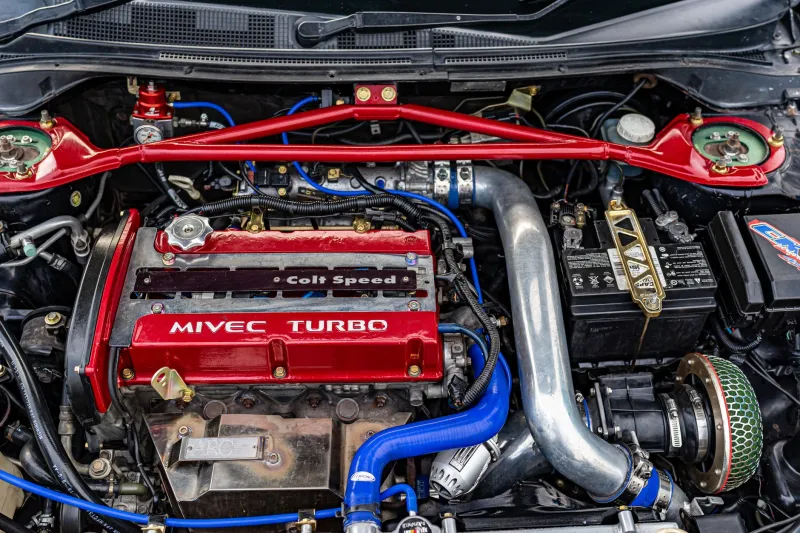
Do this with the engine cold. Never open a hot expansion tank. Find the tank, read the cap and the manual, and check the level against the MIN/MAX marks. Look at the coolant colour and condition — but don’t use colour alone to choose a top-up. If it’s cloudy, rusty, oily or full of particles, that’s a diagnosis job, not a top-up job.
Check the hoses for soft spots or cracks, the radiator for damp patches, and the water pump area for a weep. Look under the oil filler cap for mayonnaise-like sludge, and check the dipstick for coolant contamination. If the coolant looks like milkshake, stop and get it inspected.
Winter strength testing
Antifreeze does two jobs: it lowers the freeze point and raises the boiling point, and it protects against corrosion. A weak mix might survive a mild UK winter, but a cold snap can freeze it in the block or radiator. Water expands when it freezes, and that can crack castings and radiators. A refractometer or hydrometer test takes seconds and tells you the glycol concentration. Most cars want a mix that protects well below UK winter temperatures, but follow the manufacturer’s figure.
Don’t judge by colour or smell. Don’t top up with neat antifreeze either — too much glycol can reduce heat transfer and cause overheating. Use pre-mixed coolant or mix distilled water and concentrate to the correct ratio.
When a flush is genuinely needed
Not every low coolant level needs a flush. A small top-up with the correct spec is fine. A flush is for contamination, wrong coolant mixed in, a failed water pump, a heater matrix that’s blocked, or a service interval that’s genuinely due. Even then, the system needs the right procedure: drain, flush with the correct agent, refill with the specified coolant, and bleed properly. Some cars need a vacuum fill to avoid air locks. A heater matrix may need a separate backflush.
If the heater is cold on one side, the temperature gauge climbs at idle, or the coolant keeps disappearing without a visible leak, get it pressure-tested. A head gasket test is cheaper than a head gasket job.
The tenner that saves four figures
Before you grab the first bottle on the forecourt shelf, take a photo of your coolant cap and check the spec. Keep a litre of the correct pre-mixed coolant in the boot if you’re the forgetful type. It’s a dull bit of car ownership, but it’s cheaper than a heater matrix, a water pump and a head gasket. Colour is a hint. Specification is the rule.