Cold Morning, Hot Wires: The Safe Way to Boost a Modern Car — And the Bill When You Don't
It's 7:40 on a Tuesday in November. The windscreen is frosted, the kids are late, and the car makes that flat, hollow click instead of a crank. Out come the jump leads from the boot, borrowed from a neighbour who's already got his engine running. Ten minutes later the car starts — and three weeks later it's in a workshop with a bill that has nothing to do with the battery.
That sequence is more common than you'd think. A boost is one of those jobs that feels universal, like topping up washer fluid, but modern cars have changed the rules. What worked on a 1994 hatchback can be an expensive gamble on a 2019 family estate with stop-start and a body control module that watches every volt.
Your Dad's Escort Didn't Have Thirty Computers
A modern car isn't just a starter motor and a coil. There are dozens of electronic control units — engine, gearbox, ABS, airbags, climate, central locking, infotainment — and many of them wake up the moment they see voltage at the terminals. A jump-start isn't simply feeding the starter; it's sending a sudden supply to modules that have been asleep, some of which are sensitive to spikes and reverse polarity.
That's before we get to the battery itself. A conventional lead-acid battery and a modern AGM or EFB unit behave differently under load, and they want to be charged differently too. Treat them the same and you're guessing.
AGM and EFB: The Batteries That Don't Like Surprises
If your car has stop-start — and most UK cars built in the last decade do — it probably runs an AGM (absorbent glass mat) or EFB (enhanced flooded battery). These are designed for repeated deep cycling and rapid recharge, and they're paired with a battery management system that keeps a running tally of charge and health.
That matters because a flat AGM isn't a blank slate. The car's charging strategy is based on what the management system thinks it knows. If you boost it, drive it for ten minutes and park it again, the system may still be working from stale assumptions. A garage will often need to test the battery properly and, on many models, register the new one to the car so the charging profile resets.
Cheap boost packs and old-fashioned trickle chargers can also be rough on these batteries. A pack that dumps a high surge into a deeply discharged AGM is not doing it any favours. Nor is a charger left on a battery that's already full.
Where the Money Actually Escapes
Most jump-start damage comes down to a handful of repeat offences:
- Reverse polarity. Red to black, black to red — it happens in the dark. On a modern car this can take out main fuses, the alternator and, in the worst cases, an ECU.
- Spikes from a running donor. Connecting leads while the donor engine is revving, or disconnecting in the wrong order, can send a voltage spike through the system.
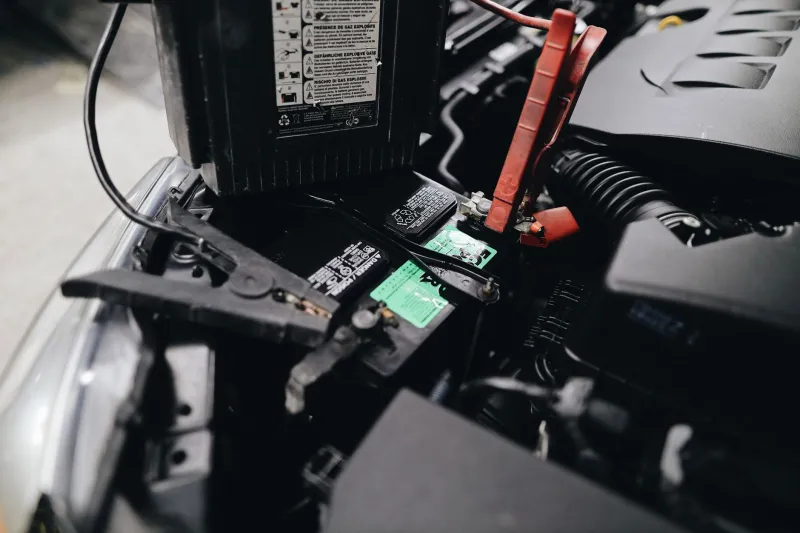
- Earth connection in the wrong place. The negative lead should go to a chassis earth point or the engine block, not straight onto the flat battery's negative post. That last connection is where the spark happens, and you want it away from the battery.
- Leaving the booster connected. Once the car fires, get the pack off promptly. Leaving it attached while the alternator charges can confuse the management system.
- Keys in, lights on, everything awake. A car with the ignition on and modules live is more exposed to a spike than one that's fully asleep.
The Procedure We'd Use on the Forecourt
This is the sequence we'd follow on a conventional petrol or diesel car with a flat battery. If your handbook says something different — and some do — follow the handbook.
- Check the battery type and condition first. If the case is swollen, cracked, leaking or frozen, stop. Don't boost it. A frozen battery can rupture.
- Switch everything off on both cars. Ignition off, keys out where possible, lights, radio, climate and charging cables unplugged.
- Connect red to red. Positive lead to the flat battery's positive terminal, then to the donor battery's positive terminal.
- Connect black to the donor negative, then to a chassis earth on the dead car. A metal engine bracket or suspension turret works; avoid fuel lines, painted panels and the battery negative post itself.
- Start the donor car and let it idle briefly. Then try the dead car. If it doesn't fire within a few seconds, stop cranking and give it a minute.
- Remove the leads in reverse order. Dead car's earth first, then donor negative, then donor positive, then dead positive. Don't let the clamps touch each other.
- Keep the revived car running and drive it. Twenty minutes of mixed driving is better than idling on the drive. Idling won't put meaningful charge back into a flat AGM.
Pick Your Donor Carefully
Not every good Samaritan is a good donor. Avoid using a hybrid or electric vehicle as a donor unless its handbook explicitly says otherwise — the 12-volt systems on those cars are managed differently. Avoid a donor with its own electrical gremlins, a flickering dash or a battery that's clearly on its way out. And if the donor is a modern car with stop-start, don't sit there revving it to 'help' — let it idle.
What a Garage Checks After a Bad Boost
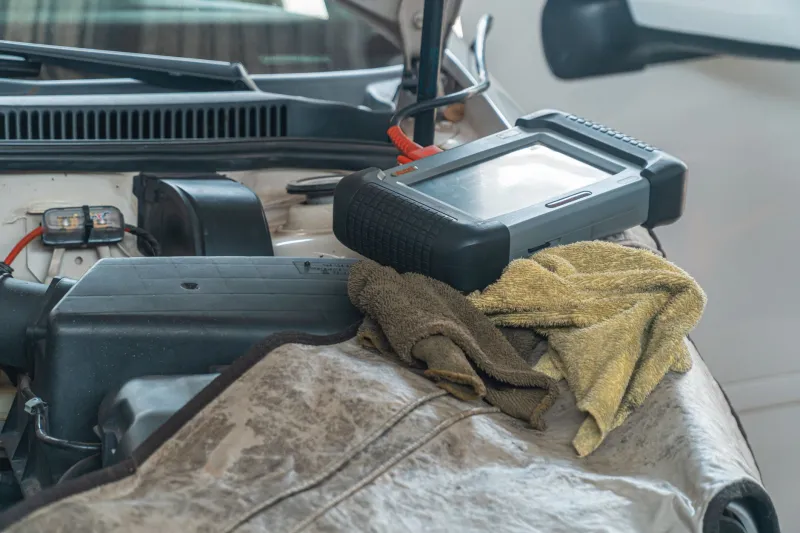
When a car comes in after a jump-start that didn't go to plan, we don't just swap the battery. We read the fault codes, check for stored undervoltage events across modules, test the battery properly and check the charging system under load. We look at main fuses, inspect the battery terminals for heat damage, and confirm whether the battery management system needs resetting or registering. Sometimes the fix is a battery and a code clear. Sometimes it's a module that's had enough.
When to Put the Leads Down and Call Recovery
If there's a burning smell, smoke, a swollen battery or any sign of leaking electrolyte, stop. If the car is keyless and the dash is completely dead even with a donor connected, don't keep cranking. If you're on a smart motorway hard shoulder, the safest boost is the one done by a recovery operator with the right kit. And if your car is an EV or plug-in hybrid, read the handbook before anyone goes near it with jump leads.
The £900 Lesson
The arithmetic isn't complicated. A replacement AGM battery, fitted and coded, is often £180 to £300 depending on the car. A diagnostic session is £60 to £100. A damaged module can run from £400 to £900 or more once you've paid for the part and the coding. Recovery is £100 to £250. Against that, a decent trickle charger and an autumn battery health check look like pocket money.
A jump-start is a rescue, not a repair. Get it right, drive the car properly afterwards, and get the battery tested before the next cold snap. Get it wrong and the click you heard on the drive is the cheapest part of the story.