The Half-Stamped History: Reading a Used Car's Paper Trail Like a Forecourt Mechanic
A service book with three stamps and a hopeful expression is one of the most common sights on a used forecourt. The seller calls it 'part history'. The buyer sees empty boxes and hears alarm bells. Both reactions are a bit too simple. In the workshop, we do not treat a missing stamp as proof of neglect, and we do not treat a full book as proof of care. We read the paper trail — and the digital one — like a set of clues.
Start With the Evidence Chain, Not the Empty Boxes
Service history is not one document. It is a chain: the service book, the receipts, the MOT record, the V5C, the digital service record held by a manufacturer, and whatever a diagnostic scan can pull from the car's modules. A missing stamp tells you the book was not stamped. It does not, on its own, tell you the oil was never changed. Plenty of owners use an independent garage that logs the work on a receipt but never touches the book. Plenty of others lose the book entirely and keep a folder of invoices in the glovebox.
So before you write off a car, ask what evidence exists around the gap. A stamped book with no invoices is weaker than a patchy book with itemised receipts. A digital record printed by a franchised dealer can be stronger than either.
What a Garage Can Actually Verify
A workshop cannot invent history, but it can check quite a lot before you hand over money.
- Manufacturer digital service records. If the car has been serviced within the franchise network, a dealer can often pull the record using the VIN. Ask for a printout, not a verbal 'it's all online'.
- MOT history. The DVSA record is free and gives you mileage at every test, plus advisories and failures. It is the simplest audit tool you have.
- Receipts and invoices. Look for dates, mileage, VAT numbers, part numbers and labour descriptions. An invoice for 'oil and filter' is useful; a till receipt for a bottle of oil is not.
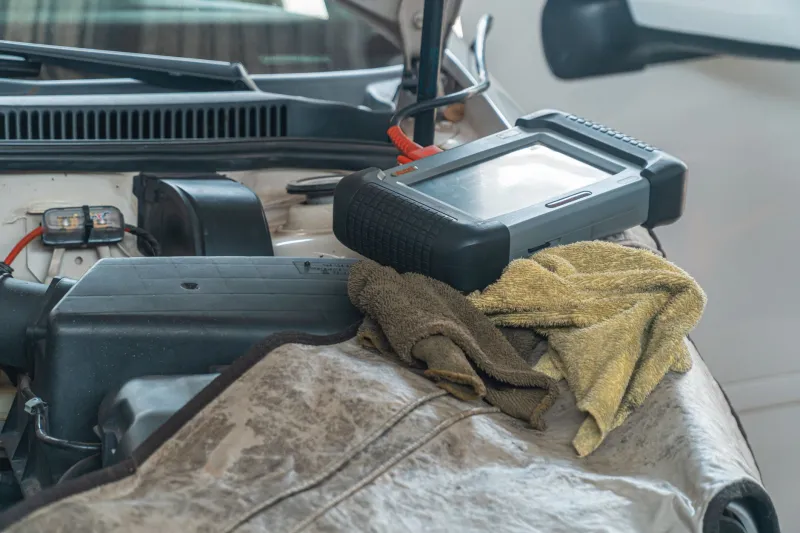
- Diagnostic scan. On many modern cars, service interval counters, stored fault codes and module mileage can corroborate or contradict the paperwork.
- Visual checks. Oil condition, filter dates, brake fluid colour, coolant condition and obvious leaks tell a story, though they cannot prove a cambelt was changed.
Not every independent garage can access every manufacturer portal, but a franchised dealer usually can. If a seller refuses to let you verify the VIN or book an inspection, that is a different kind of red flag.
The Gaps That Matter More Than Others
A missing stamp at 12,000 miles on a five-year-old car is rarely a deal-breaker. A missing major service on a modern turbo petrol or a diesel with a wet belt is a different conversation. The gaps worth worrying about are the ones that sit around expensive, interval-critical work.
- The first service. On a new or nearly new car, a missing first service can affect warranty and suggests early neglect.
- Long mileage gaps. If the book shows 18,000 miles between stamps on a car with a small turbo engine or a DPF, ask why. Modern oils cope with a lot, but not with infinite neglect.
- Major interval items. Wet belts, timing belts, DSG oil, brake fluid, coolant, spark plugs and gearbox services all have intervals for a reason. If the paperwork cannot prove they were done, price them in.
- MOT mileage that moves backwards. A service at 60,000 miles followed by an MOT at 40,000 miles is not a paperwork error you should ignore.
- Stamps with no invoices for big jobs. A stamp saying 'cambelt' is helpful; an invoice showing the belt, tensioner and water pump is better.
- A gap right before sale. If the last stamp is two years old and the car is being sold with a fresh MOT, remember that an MOT is not a service.
Digital Records and Independent Receipts
Digital service history is normal now, especially on cars from the last decade. Do not dismiss a car because the book is blank — but do ask for the digital printout. A main dealer can usually provide it, and it should show date, mileage and the work done.
Independent garage receipts can be just as good, sometimes better. A proper invoice with the registration, mileage, parts and labour is a solid record. What you want to avoid is the opposite: a fully stamped book with no supporting invoices, especially if the stamps are vague and the car has a reputation for expensive interval work. Stamps are easy to collect; receipts show what actually went on the car.
MOT Mileage: The Free Audit
Before you view the car, pull its MOT history online. You want to see steady mileage progression and advisories that make sense for the age of the car. Big jumps, long periods off the road, or mileage that dips can point to clocking or a broken odometer. The MOT record will not tell you whether the oil was changed, but it will tell you whether the service book's mileage story hangs together.
Advisories are useful too. Repeated notes for tyres, brakes, corrosion or suspension suggest a car that has been run on a shoestring. That does not automatically make it a bad buy, but it helps you build a realistic catch-up budget.
How to Price the Risk
A gap in history is a negotiation tool, not always a walk-away. If the car is otherwise sound, ask a garage to quote a baseline service: oil and filter, brake fluid, coolant check, pollen filter and anything else due by age or mileage. If a wet belt or cambelt is unproven, get a quote for the full job with tensioner and water pump. Use those figures to adjust your offer.
The maths is simple. A car with a patchy history but a £600 catch-up bill may still be good value. A car with a patchy history and an unproven wet belt on an engine known for belt failure is a much bigger gamble. The point is to price the unknown rather than pretend it is not there.
The Forecourt Checklist
Ask for the VIN, the registration, the service book and every receipt the seller has. Photograph them. Check the MOT history before you travel. Ask the seller to arrange a digital service record printout if the car is franchised. Book a pre-purchase inspection if you are serious. A good garage will plug in, check the mileage in the modules, look for stored faults and tell you what the paperwork cannot.
A service book is a story with missing pages. Your job is not to demand a perfect book on a used car — it is to work out whether the missing pages hide routine admin or a bill you are about to inherit.