When Stopping Goes Quiet: The Rusty-Disc Trap in Hybrid and EV Brakes
Hybrid and electric cars have a clever party trick: they slow down without asking much of the brake pads. The electric motor becomes a generator, drags a bit of energy back into the battery and the car sheds speed almost silently. It is efficient, it is smooth and, in a British winter, it can also be the reason a set of brake discs quietly turns into a rusted, scored mess.
That is not a design fault. It is simply a consequence of how regenerative braking works. The friction brakes are still there, still legally required and still needed for hard stops, hill holds and the last few mph before you come to rest. But on a lot of hybrid and EV journeys they do far less work than they did on a conventional petrol or diesel car. Less work means less heat, less cleaning action and more time sitting in damp air with road salt on them.
At Donnelly VRS Ltd, we see the results on the forecourt: low-mileage hybrids with shiny paint and discs that look like they have been left in a rock pool. The owner is often surprised. The car stops fine in normal driving, so why is the garage talking about corrosion?
The brake disc is a wearing part, but rust is a different problem
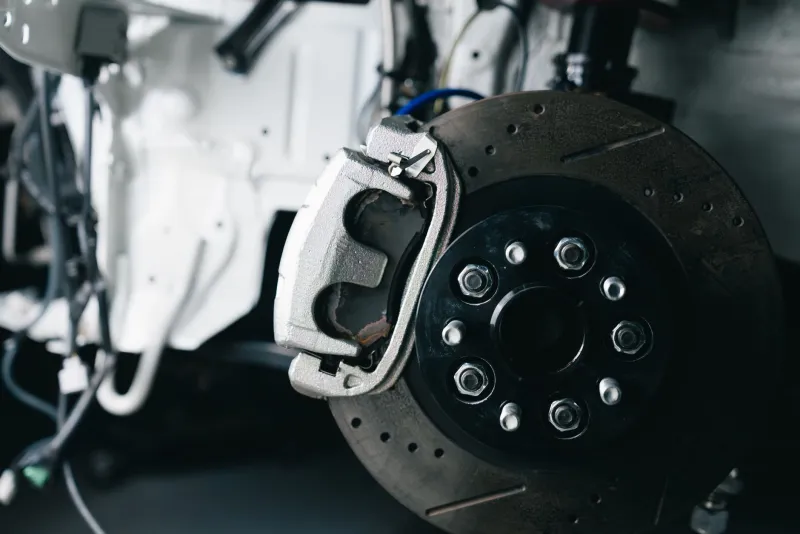
A brake disc is bare cast iron on most cars. It has no paint on the friction face because paint would not survive the heat and would ruin braking. Bare iron plus water plus oxygen equals rust. That is normal. What is not normal is rust that gets a chance to sit and bite because the pads are barely touching the disc.
On a conventional car, every trip involves a bit of friction braking. The pads wipe the disc face, warm it up and dry it off. On a hybrid or EV, the car may go days or weeks without using the friction brakes much at all, especially if the driver is light on the pedal and does mostly short, gentle runs. Add a chilly November, wet roads and a council gritter, and the discs can develop a layer of surface rust that never gets polished away.
Surface rust alone is not a crisis. The MOT tester is not going to fail a car just because the discs look orange after a wet weekend. The trouble starts when the rust becomes pitting, when the disc edge flakes, when the pads stick in their carriers or when the inner face of the disc — the side you cannot see through the wheel — gets far worse than the outer face. That is where the advisory turns into a repair.
What drivers actually notice
Hybrid brake problems rarely announce themselves with a dramatic failure. They creep in. You might hear a low grind for the first few stops of the morning, then it disappears. You might feel a slight judder through the pedal when you brake from 50mph, or a squeal that comes and goes. Some cars develop a 'wooden' pedal feel because the friction brakes have not been exercised properly in a while. Others pull slightly to one side under braking because one caliper is doing less than the other.
A stuck rear caliper is a common one, particularly on cars with an electronic parking brake. The rear brakes on a hybrid often do even less work than the fronts because the motor handles most of the slow-speed drag. If the parking brake is applied every night and the car sits for days, the pads can bond slightly to the disc. The first drive then drags them free, leaving a patch of rust or a scored ring that never quite cleans up.
There is also the owner who says: 'But it stops perfectly.' That is the point. A hybrid can mask a lot of brake neglect because regeneration does so much of the everyday stopping. The friction brakes only reveal their true condition when you need them hard, when the battery is full, when the car is loaded or when you are coming down a long hill. That is not the moment to discover a seized caliper or a disc that has lost half its thickness to corrosion.
The MOT advisory worth reading twice
An MOT advisory for 'corroded brake disc' or 'brake disc worn, pitted or scored' is not automatically a fail, but it is not wallpaper either. It is a note from the tester that the disc has moved beyond normal surface rust. The question is how far.
A light advisory may simply mean the car needs more regular use of its friction brakes and a proper inspection. A more serious note — especially if it mentions weakness, excessive corrosion or a disc that is significantly pitted — deserves attention before the next MOT, not after it. Brake discs are safety-critical. A corroded disc can crack, warp or wear pads unevenly, and a caliper that has seized will often take a set of pads and a disc with it.
The other trap is the 'it passed, so it must be fine' mindset. An MOT is a snapshot of one day. A disc that is borderline in November can be a problem by February, particularly if the car does low mileage and sits outside. If the advisory mentions brakes, ask the garage to show you the disc with the wheel off. A torch and a finger can tell you a lot about whether the corrosion is surface-level or starting to pit.
The monthly brake bite
You do not need a track day or a deserted airfield to keep hybrid brakes honest. You need a safe, empty stretch of road, a dry-ish day and five minutes of deliberate braking.
Find a quiet road with good visibility and no traffic behind you. From around 30–40mph, press the brake pedal firmly — not a panic stop, but enough to bring the friction brakes into play — and slow to walking pace. Do that three or four times, then let the car cool as you drive normally. The idea is to scrub the disc faces, warm the pads and exercise the calipers through their travel. On a hybrid or EV, this forces the car to use the conventional brakes rather than letting the motor do all the work.
Do it once a month, and again after a spell of wet, salty weather or a long period of short trips. If your car has a one-pedal driving mode, switch it off for the exercise so you are definitely using the brake pedal. Do not sit at traffic lights with your foot hard on the pedal for minutes on end, and do not power-wash the discs and then park the car up wet. A short drive after a wash helps dry everything off.
What a garage should check
A proper brake inspection is not just a glance through the wheel spokes. It means checking both faces of each disc, the pad thickness on inner and outer pads, the caliper slides, the handbrake or electronic parking brake operation and the brake fluid condition. Brake fluid absorbs moisture over time, and old fluid can cause internal corrosion in the calipers and ABS unit. On a hybrid, the brake blending also needs to be working correctly, so any warning lights or unusual pedal feel should be investigated rather than parked in the 'I will get to it' file.
If the discs are already pitted, scored or below the minimum thickness, no amount of gentle braking will bring them back. They need replacing, and pads should be replaced as a pair on the same axle. A seized caliper may need a new caliper, or it may be rebuildable depending on the model and condition. The earlier you catch it, the more likely you are to be paying for pads and discs rather than pads, discs, calipers and a recovery truck.
Hybrid and EV braking is one of those areas where the technology is genuinely brilliant but the maintenance routine has to change with it. The car is not broken because it uses regenerative braking. It is just doing what it was designed to do. Your job is to make sure the old-fashioned friction brakes get enough exercise to stay useful when the clever stuff hands over.
If your hybrid or EV has an MOT advisory for corroded discs, or you have noticed a morning grind that disappears by the end of the road, get it looked at before the winter salt has another go. A monthly brake bite is cheap. A seized caliper and a pair of scored discs are not.